Friday, May 17, 2019

Planting a rainbow

The children planted flower seeds this week after reading the book Planting a Rainbow by Lois Ehlert. The children filled their pots with soil, made a hole for the seeds, covered the seeds with soil and watered the flowers. We talked about about the differences between dirt and soil and discussed what we needed to do to help the flowers grow.


We have continued to water the flowers each day and discuss what they will look like, how long it will take them to grow and which part of the plant will come above the ground first. The children are developing observation skills, learning about responsibility by watering the plants each day and language skills by discussing their observations.

     
Adding soil

Planting a seed


Watering the plants

During the next few weeks we will continue to observe the flowers and draw our predictions of what they may look like when they sprout. We are also learning some new vocabulary such as, sprout, stem, bud and soil.

We have also deconstructed flowers to determine what the petals and stems look like when the flowers are taken apart. We explored what the petals looked like when they are fresh off the flower and when they are starting to dry out.


Monday, April 1, 2019


Raised body drawings


Previously the children have drawn above their heads by laying on their backs or standing in front of a vertical surface. In this lesson, the children explored how to balance their bodies while drawing on their bellies. We challenged the children to draw "beneath their bodies." They were excited to try a new experience with a familiar piece of equipment. We had the children try to balance their bodies on a this "mushroom top" they usually use in the gross motor room. The children approached this experience in a variety of ways. Some of the children kept their feet on the ground which made them turn more slowly. Some of the other children realized in order to spin around the stool, they needed to keep their feet in the air. As we investigate how to represent motion, the children continue to try new experiences and learn about how to control their bodies.

Julia's feet remain on the ground as she moves
 her body around the mushroom top.
Sandile uses her left hand to support
herself while she is drawing


Matthew says, "I am balancing!" and occasionally
removes his supporting hand from the ground 
Reda draws in large sweeping movements across
the paper He is well in control of his body and uses
his hand to push himself back and forth.


This exploration can be linked to numerous standards from our assessment, including
  • 5. Demonstrates balancing skills
  • 7. Demonstrates fine-motor strength and coordination
  • b. Uses writing and drawing tools
  • 11. Demonstrates positive approaches to learning
  • a. Attends and engages
    b. Persist
    c. Solves problems
    d. Shows curiosity and motivation
    e. Shows flexibility and inventiveness in thinking


Friday, February 22, 2019

Representation of Motion

The children have been very interested in how objects move. We have used balls and cars on ramps and have explored tops on the classroom floor. To extend the children’s understanding of how tops move, we dipped them in paint so the children could visualize the path the tops took across the paper. At first the expected the tops to make a straight line across the paper. They seemed  surprised to see the tops create a curved path.


Learning Objectives during this experience:

·      7. Demonstrates fine-motor strength and coordination
a.   Uses fingers and hands
·      9. Uses language to express thoughts and needs
a. Uses an expanding expressive vocabulary
b. Speaks clearly
·      11. Demonstrates positive approaches to learning
a. Attends and engages
b. Persist
d. Shows curiosity and motivation
e. Shows flexibility and inventiveness in thinking
·      24. Uses scientific inquiry skills
·      26. Demonstrates knowledge of the physical properties of objects and materials

Sunday, January 27, 2019


Ms. Fuller was our Strategy student last semester. Here is a note from her:


Hi, My name is Tierra Fuller and I am excited to be the intern in your child's classroom every Friday this semester! Many of you may have seen me last semester in the classroom for another class and I was very happy when I found out I would be able to return to the same classroom to continue building relationships with your children.
 I am currently completing my bachelor’s degree with a study in Children and Families from University of Michigan-Dearborn and will graduate this April. I have been working with preschool children for the past 4 years and have also worked in daycare centers with infants through 7-year old. When I am not in school or working, I love shopping, reading, and spending time with my family.

I look forward to an amazing time filled with fun and learning over the next
few months that I will be in the classroom. Throughout the semester I will be interacting and observing the children, as well as creating lessons alongside Ms. Finkelstein that interest the children. I look forward to an amazing time filled with fun and learning over the next few months.


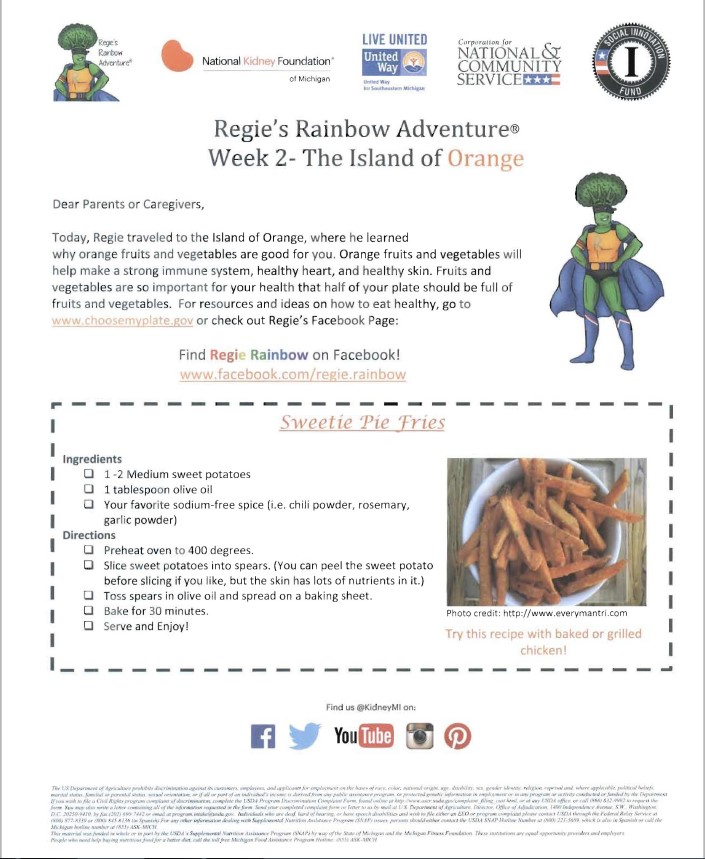
Regie Rainbow Week 2
Last week the children were introduced to orange fruits and vegetables. We tasted sweet potatoes and acorn squash. Every week when the children taste one of the foods of the week, they get a power band of that color. You will know if your child tasted either of the foods each week, if they have a colored piece of tape around their arm. This is their "power band." Here is some information about this week's adventure!


Wednesday, January 16, 2019

Welcome to the Room 6 blog!

Since we've been back at school the children have been showing an interest in animals and their habitats, as well as tunnels and bridges. We will continue to explore both of these topics and see how they develop.
Using a combination of recycled materials and school blocks James and Deegan
created a tunnel with a ramp. They observed how the car was traveling along the path and through the tunnel.


Ahmad noticed that if the plank was laying flat, he needed to push the car in order for it to move.


Tuesday, March 27, 2018

Investigating Maps 3/28/2018

Investigating Maps 


During play, we noticed children drawing on a piece of paper, rolling it up, and using it as their "map". They seemed so interested, we had to investigate further!

I asked the children what a map was for. Abi replied "It helps you get somewhere!" They understood that a map gives directions, but they were still figuring out how it worked. First we printed small examples of maps and asked children to draw their own. Many of them added their house, the school, and roads to their picture.
Ali K., James, & Abigail draw their own maps with inspiration from printed examples.


To extend on their map knowledge, we introduced a large map of the United States. We noticed the children being very invested in this because they could relate it to trips they had taken. Many of our students have traveled this year and enjoyed a visible representation of where they had been. Measurement and comparison skills were incorporated as they saw how close or far places were. They also practiced positional words while seeing that they traveled close, far, up, down, or next to other places.
Camellia, Madison, Talia, & Reda explore a large map. They talk about places
 they have driven or flown and we mark them on the map. 

After gaining more experience and knowledge of maps, we revisited the idea of drawing our own. We noticed the children's drawings become more thoughtful and detailed. They were adding more detailed roads and more than one destination.


            Josiah's map included his house, a road, and the school.
          While drawing, he said,
            "This is where my Auntie drives me".

Lucas used long lines and dots to create his map.
Adam's map includes his house, school, a market, and the road.

Stella said, "My road is taking me to Target". She drew her house
Target, her school, and some roads. 

Talia created a "Map to School". She added her house, the parking lot,
the road, and the school.
Maya created a map with many details including a restaurant
and her vacation!


We are excited to extend on this interest and see how the class learns and understands maps & directions in a new way. 

Friday, March 2, 2018

Exploring building

Using a variety of materials for building

During the last few months the children have been using many different materials to build. In addition to regular building blocks, we have used large magnetic tiles, recycled materials and combined different types of blocks together. They have discovered that different materials require different strategies for building and that a strategy may work with one type of material and not another. 

Adam and Joe work together to build a castle
The children are using recycled materials
to build homes for  the animals

Throughout this process the children also developed group cooperation and communication skills. They realized they needed to talk with the other children and share their ideas. Otherwise, everyone was doing something different.


The magnetic tiles offered a unique challenge to the children. If they built multiple levels on one side and not the other, the weight of the tiles caused their structure to fall. After a teacher encouraged them to build the second level all they way around, the children realized they could  successfully create a multi level structure.

Changing the building surface

Another challenge we have presented to the children is how to build on different surfaces. We placed blocks in the sand table and discovered the children simply moved the sand to the side to build or used the lip of the sandtable as a stable surface. In order to stretch their thinking, we brought in an incline plane and encouraged them to build with the ramp as their surface.


We began by using small, foam blocks  on the ramp. The children noticed that many of the blocks slid down the ramp. After trying to build in different places on the ramp, Violet and Rory realized the direction of the block was important to it staying in one place. Ahmad worked with Rory to build up once the base block was stable. 

Our next step will be to use small, wooden blocks on the ramp. Some questions we will be looking at with the children are: Will the wooden blocks provide the same challenges as the foam blocks on the ramp? Will the children use the same strategies with the wooden blocks and will their strategies work the same way?  

Friday, December 22, 2017

Welcoming the Snow 12/22/17

It has snowed a lot lately!


The weather change made a big impact on the children's daily lives. Not only did their outside environment begin to look very different, but there were changes in their daily routine as well. The snow and cold temperatures meant that some days we had to stay in the classroom and other days it took a long time to put on our snow gear! As a class, we started to explore the snow and ice that had become a part of the world around us.

The children all gather to look out the window as the playground gets covered in snow.

Piles of snow are a unique canvas! They used eye
droppers to add color and watched as it
moved and spread.

If it is too cold to go to the snow, we can make the snow
come to us!


To inspire their building, we pretended it was snowing in the block area! This challenged the children to build structures that would keep their animals warm and dry. 


Reda figures out that a roof will keep his Tiger
safe from the snow. "They need a jacket", he
says while he builds.

Stella builds a home for her animal. "He needs
a roof to keep him nice and dry in winter time."


Abigail starts by creating walls all around to
keep the snow off of her zebra.

Jad and Talia work together to create a structure
with a roof. 


Friday, December 1, 2017

12-1-17

Recognizing our Names

The first word children learn to read and write is their name! We have created many opportunities for them to practice this skill in the classroom. 

Each day children should be finding their own nametags to put on their cubbies. 


After putting away their things and washing hands, we invite everyone to sign-in. We can help or this can be a special thing you do with your child before saying good-bye! 

At the back of our classroom is our classroom community space. This is an interactive area with each child's picture, name, and a collage they created. The children have enjoyed finding themselves, looking at their name, and seeing their classmates' as well. 


We play a variety of letter games each day! Children learn letters, starting with those in their name, through exposure. This means playing, drawing, singing, feeling, and moving with letters!


Developing an understanding of details through self-portraits
Some of our project work this semester has focused on creating self portraits through an exploration of the smaller details.

 At the beginning of the year we always have the children draw a self portrait for their portfolio. As the children drew their faces, we noticed a disconnect between what they were  observing in the mirror and what they were representing on  paper.  Our first step to help the children notice details was to provide them with the outline of a face and have them add the facial features.  As a result, some children were placing facial features in the general location where they are found on the faces while others were drawing random shapes without regard to the location of facial features. 


The children began this investigation by drawing self portraits. We provided the children with an outline of a face and they added the details.

Abi uses the recycled materials to create an eye.

Khalil used the small black stones to outline the shape of the eye.

Ali E. is placing one of the beads up against his eye as a way to connect the image to his own body.

Yousef is looking at the picture of the eyes. He pointed to the image of the eyes and then pointed to his own eyes.
Throughout these experiences, the children were developing their fine motor skills, becoming observers of details and strengthening their language skills as they described what they were seeing and doing.